Table of contents
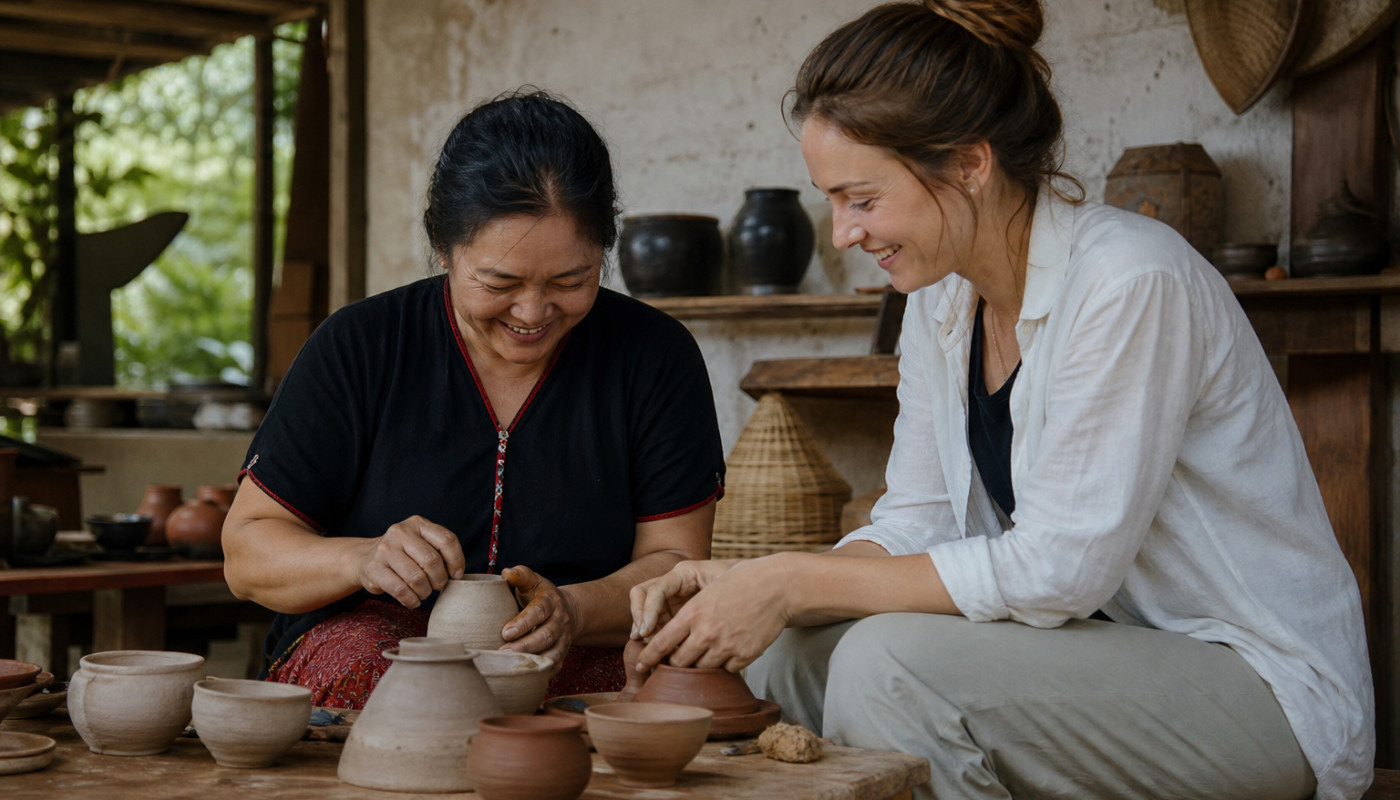
Mass tourism is wobbling, and in its place, travellers are chasing something harder to fake: hands-on time with local makers, repairers, and artisans. From Japan’s “kintsugi” workshops to Mexico’s weaving cooperatives, craft activities are increasingly booked alongside flights and museums, and they are reshaping what “authentic” means on the road, with measurable spillovers for local incomes, heritage transmission, and even visitor behaviour. The most memorable itineraries often begin, quite literally, at a workbench.
Craft classes are rewriting the souvenir economy
What if the best souvenir is a skill? The global “experiences” segment has been one of travel’s fastest-moving battlegrounds, and craft workshops sit at the sweet spot where visitors get a story, a tangible result, and the feeling of participating rather than consuming. Major travel platforms have leaned into this shift: Tripadvisor’s 2024 “Travelers’ Choice” communications and product updates repeatedly foregrounded “experiences”, while Airbnb’s long-standing bet on activities signalled years ago that travellers would pay for learning, not just lodging. The logic is simple, and it is supported by spending patterns: once a visitor pays for a workshop, they often buy materials, tools, and locally made pieces, and they tend to spend in neighbourhoods beyond the main tourist corridors.
There is also a distributional effect that traditional sightseeing struggles to match. A museum ticket is pooled into a large institution, but a ceramics class, a printmaking session, or a leatherworking lesson routes money directly to a practitioner, sometimes in small groups where the margin stays local. In destinations where housing pressure and over-tourism have turned visitor spending into a political question, that directness matters, and it is one reason municipal tourism boards increasingly highlight small-scale cultural activities. The European Commission, for instance, has repeatedly framed cultural and creative sectors as both economic drivers and identity assets, and while that is not travel-specific policy, it underpins how cities justify supporting craft districts and maker programmes.
Data points help explain the pull. UNESCO has long emphasised that intangible cultural heritage lives through practice, not display, and that safeguarding depends on transmission. A workshop is transmission made legible: a traveller can see the patience behind an inlay, the judgement in a glaze, the discipline in a loom pattern. When those sessions are run responsibly, they become micro-funding for continuity, and they also raise the perceived value of local work. The souvenir economy shifts from “cheap and portable” to “slow and meaningful”, and that changes what is stocked, what is priced, and what is protected.
None of this is automatic, and the boom has its risks. When craft activities are designed as “content” first, heritage can be flattened into a photo opportunity, and artisans may be pushed into teaching performances that leave little space for their own production. Yet where there is care, clear pricing, and community control, craft-based experiences can diversify incomes and spread demand across seasons, because a rainy afternoon still works for a workshop, and a winter weekend can be ideal for learning. The traveller gets something deeper than a purchase, and the destination gets something harder to outsource.
How workshops turn visitors into better guests
Respect is learned, not declared. A striking side effect of craft activities is behavioural: people who spend two hours learning why a material is scarce, why a pattern is symbolic, or why a process takes days, tend to move through a destination differently. They ask more questions, they take fewer shortcuts, and they are less likely to treat communities as backdrops. This matters in a moment when “authentic travel” is both heavily marketed and increasingly contested, because residents in many hotspots are vocal about feeling staged, crowded out, or reduced to service roles.
A craft lesson can be a quiet antidote to that dynamic, because it forces a shift from extraction to exchange. The rhythm of making is slower than the rhythm of sightseeing, and it creates space for context: where clay is dug, how wool is washed, which woods are avoided, what a motif means in a family lineage. Those details are often absent from guidebook highlights, yet they are precisely what travellers say they want when they talk about “real culture”. The encounter can also correct assumptions, as visitors realise that “traditional” does not mean frozen in time, and that many makers are innovating, hybridising, and responding to contemporary markets.
In practice, the best workshops are structured like good reporting: they start with the facts, they acknowledge the tensions, and they let complexity show. A weaving cooperative may discuss fair pay and intermediaries, a luthier may explain why mass production pushed certain local crafts to the brink, and a print studio may talk about sustainability, solvents, and waste. These are not digressions; they are the modern reality of heritage work. When a traveller hears them directly, the destination stops being a checklist and becomes a living system with constraints and choices.
There is also a social benefit that standard tours sometimes miss. Small-group making creates conversation, not just between visitor and host, but among travellers themselves, and it often produces the kind of human-scale memory that outlasts a landmark photo. The psychological mechanism is well documented in learning research: active participation improves recall, and a sense of effort increases perceived value. In plain terms, people remember what they struggled to do, and they talk about it afterwards, which is why craft sessions frequently become the story travellers tell first when they get home. That word-of-mouth effect is not only personal; it is a form of destination marketing that feels credible because it is rooted in an experience, not a claim.
Liverpool’s makers offer a different city narrative
Think you already know Liverpool? The city’s global image is powerful, shaped by music history, football culture, and a waterfront that signals maritime ambition, yet its contemporary identity is also written in studios, workshops, and small creative businesses that visitors can actually meet. In recent years, the UK’s cultural conversation has repeatedly highlighted how local creative economies support jobs and place-making, and Liverpool’s wider region has leaned into that with clusters that mix art, design, fabrication, and community education. For travellers, this opens a route into the city that is less about iconic stops and more about the people who make things now.
Craft and maker activities here connect naturally to the city’s industrial inheritance. Port cities have long been places where materials arrive, skills circulate, and styles cross-pollinate, and Liverpool is no exception, whether you are looking at print culture, textile work, metal fabrication, or contemporary ceramics. The appeal for visitors is that these practices do not sit behind glass, and they can be encountered through classes, open studios, and markets that put a face to the work. Planning that kind of itinerary is easier when you use a dedicated local guide, and travellers looking to map workshops and neighbourhood-led experiences can start with https://www.liverpool-trip.com/, which gathers practical ideas for building a stay around the city rather than just its headlines.
For Liverpool specifically, craft-based activities also help rebalance the tourist map. The classic first-time circuit is concentrated, and it can be done quickly, but learning-focused stops encourage visitors to move between districts, spend longer in independent spaces, and eat locally because workshops tend to anchor you near small cafés and markets. That matters for businesses that do not benefit from stadium-day surges or peak-season crowds, and it spreads tourism’s gains more evenly. It also produces a fuller civic portrait: a city is not only its monuments and museums, it is its labour, its training, and its everyday creativity.
There is a final advantage that is easy to overlook. A craft session is weather-proof, timetable-proof, and often budget-flexible, because there are entry-level formats alongside intensive masterclasses. For families, it can turn a trip into something intergenerational; for solo travellers, it can be an easy way into conversation without the awkwardness of forced socialising; for repeat visitors, it offers novelty without chasing “hidden gems” that locals are tired of seeing commodified. In that sense, Liverpool’s maker scene is not a niche add-on, it is a lens through which the city feels current, and it is an antidote to the idea that authentic travel must be remote or rustic.
Getting it right: ethics, pricing, and real learning
Authenticity has a cost, and it should. The most responsible craft experiences price in fair labour, decent materials, and the time it takes to teach well, and travellers should treat unusually cheap workshops as a warning sign rather than a bargain. A two-hour class that includes tools, safety equipment, and take-home pieces cannot be priced like a mass tour without someone absorbing the loss, and too often that “someone” is the maker. Transparent breakdowns, clear group-size limits, and realistic output expectations are hallmarks of an operator who values craft rather than exploiting it.
Ethics also extend to content. A serious workshop should name its sources, explain what is being borrowed, and avoid costumes or invented rituals designed for visitor consumption. In places where craft is linked to indigenous identity or marginalised communities, consent and benefit-sharing are not optional, and travellers should look for signals that hosts control the narrative, from who leads the session to where the money goes. UNESCO’s framework around intangible cultural heritage, while broad, is useful as a mental checklist: transmission, community involvement, and respect for meaning matter at least as much as technique.
Practicalities can make or break the learning. Good organisers specify what you will actually do, what you will take home, and what level is assumed, and they build in time for mistakes because mistakes are where teaching happens. They also protect the maker’s workspace, which means a clean safety briefing, boundaries around filming, and sometimes restrictions on step-by-step recording that would allow designs to be copied. That can frustrate a traveller chasing content, but it is often the difference between supporting a living craft and contributing to its dilution.
Finally, travellers should interrogate their own expectations. A “local craft” is not automatically ancient, and a modern maker using digital tools is not less authentic than someone working by hand, because authenticity is about truthful context, not nostalgia. The best journeys are shaped by that honesty, and they leave room for the destination to be complex, contemporary, and sometimes contradictory. If you come home with a bowl you made, a print you pulled, or even just an understanding of why something takes time, you have gained more than an object, and you have participated in a local economy that rewards skill.
Plan a craft-led trip, then book smart
Reserve workshops early, especially on weekends, and confirm what is included, from materials to shipping for fragile pieces. Set a realistic budget: well-run classes cost more, but they usually deliver better teaching and fairer pay. Check local listings for discounts, and look for city or regional cultural programmes that subsidise community studios, which can make sessions more affordable without squeezing makers.
Similar articles
Itinerary Chaos Or Curated Adventure: What Shapes An Unforgettable Trip?
Is Slow Travel The Secret To Discovering Hidden Destinations?

The Overlooked Link Between Visual Storytelling And User Engagement In Course Galleries

Unveiling the Mysteries of Siberian Shamanism